Bookli automatically pays out your revenue to your linked bank account. Payouts run automatically every Monday morning, and the results are recorded so you can always see what was paid out and what was withheld.
This page covers:
How your payout amount is calculated
Why we sometimes withhold part of your balance
How to read your payout history
How to download an account balance
Below is an overview of what happens from when you receive a payment until you get the money paid out to your bank account. The overview also provides insight into the timeline of the payout process.
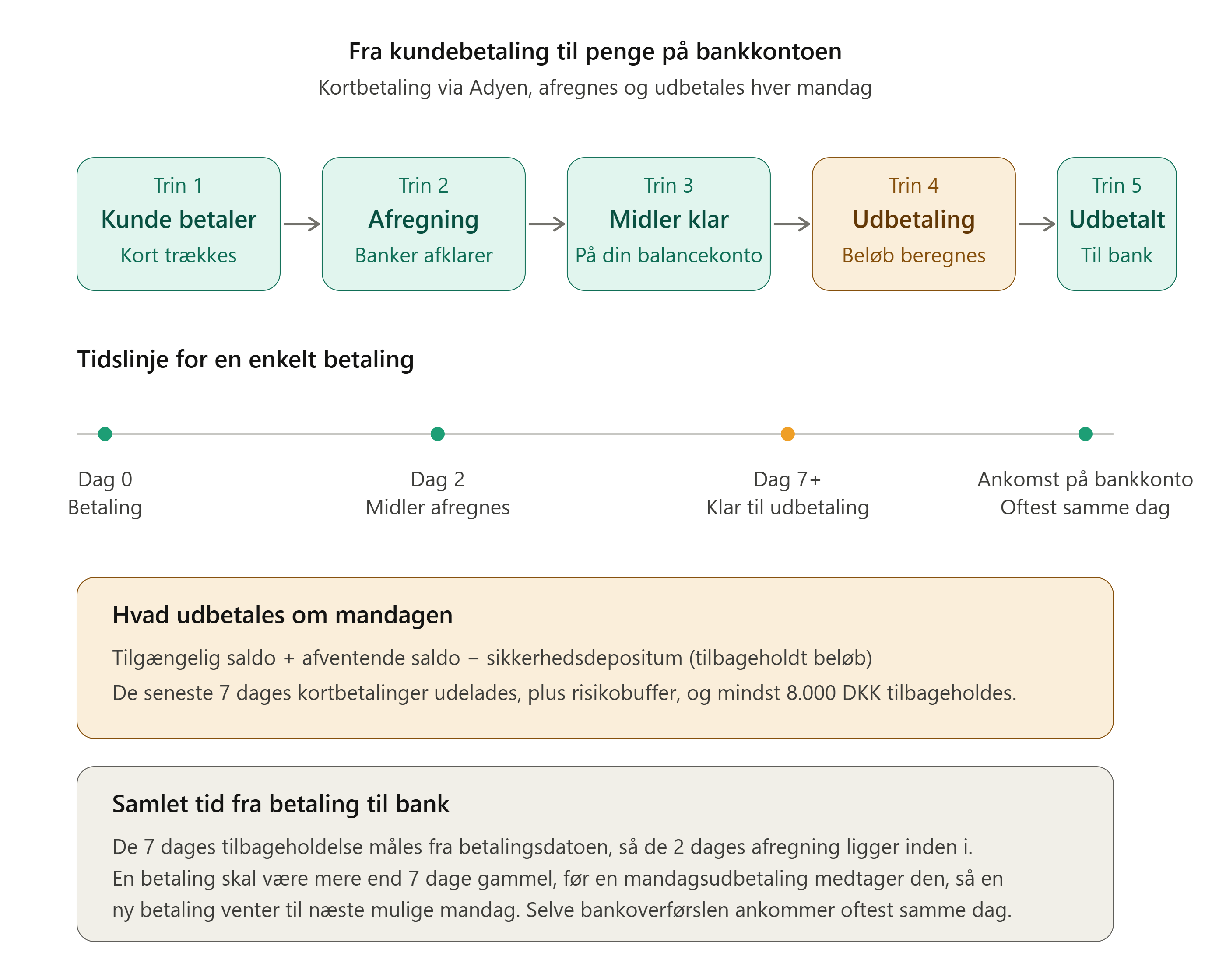
In Bookli you will find a page where you can see information regarding payouts, under the menu item "Finance" and then in the "Payouts" tab.
The page looks like this, and below you can read more about the features:
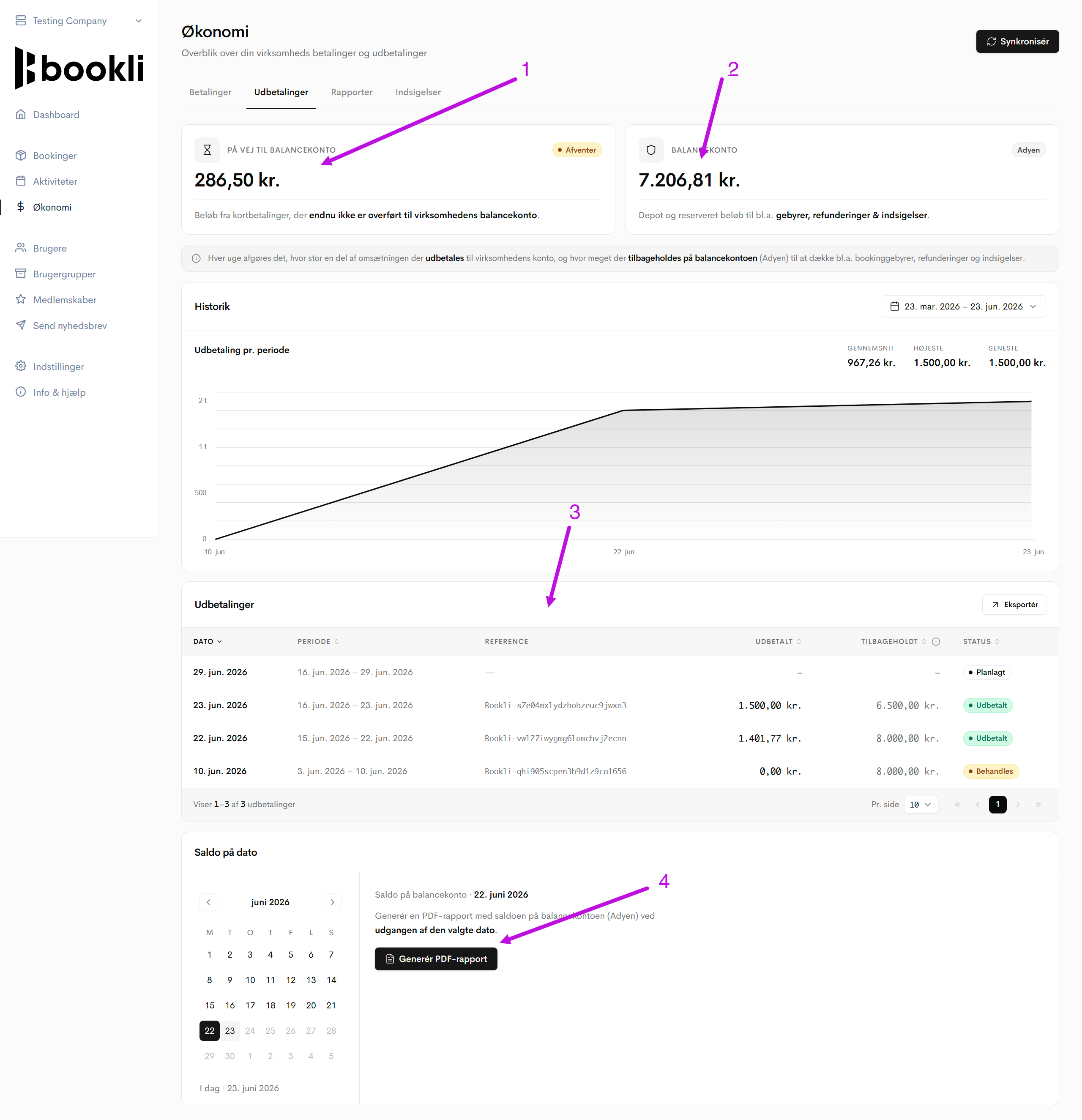
Your balance account is a virtual bank account that you have with Bookli.
It contains two types of balance:
On the way to balance account (1) — funds that are being settled between the acquirer and the customer's bank.
Balance account (2) — funds that have been fully processed. This is money you have available at Bookli, and it will be paid out, and some will be retained to cover refunds and fees.

Each payout is displayed in the list, with the following information. Note that the next payout is always shown at the top as "Scheduled", but the amount is calculated only on the scheduled date.
Field | What it means |
Date | When the payout was/will be generated. |
Period | The period primarily used to calculate the retained amount. |
Reference | Unique reference that appears on the bank transfer |
Paid out | Amount transferred to bank account |
Retained | Amount that is retained to cover refunds, disputes, fees, etc. (You can read about how it is calculated further down.) |
Status | Status of the payout. |
You can download a PDF document for any date. The statement shows:
The date of the statement
The closing balance on that date
Your business name, address and CVR number
This is useful for bookkeeping and reconciliation, as your balance account in Bookli will have a corresponding balance account in your accounts. Note that the report is based on the balance of the balance account, and therefore does not include money that is "in transit" from card payments.
Every Monday morning we calculate how much should be sent to your bank account. The purpose is to pay out your revenue, while maintaining a small security buffer on your account to cover any refunds, fees and disputes.
The payout amount is calculated as follows:
Total balance account balance − last 7 days revenue − security deposit = payout amount
Here is what each part means:
Last 7 days turnover: We look at your card payments and refunds from the last 7 days and set that amount aside.
Security deposit: In some cases we retain a little extra, based on a larger risk calculation. Below are some of the situations described:
If your turnover over the last 7 days is low compared to the last month
If the balance on your balance account is below 8,000 DKK
High risk rate on many payments (calculated by card networks)
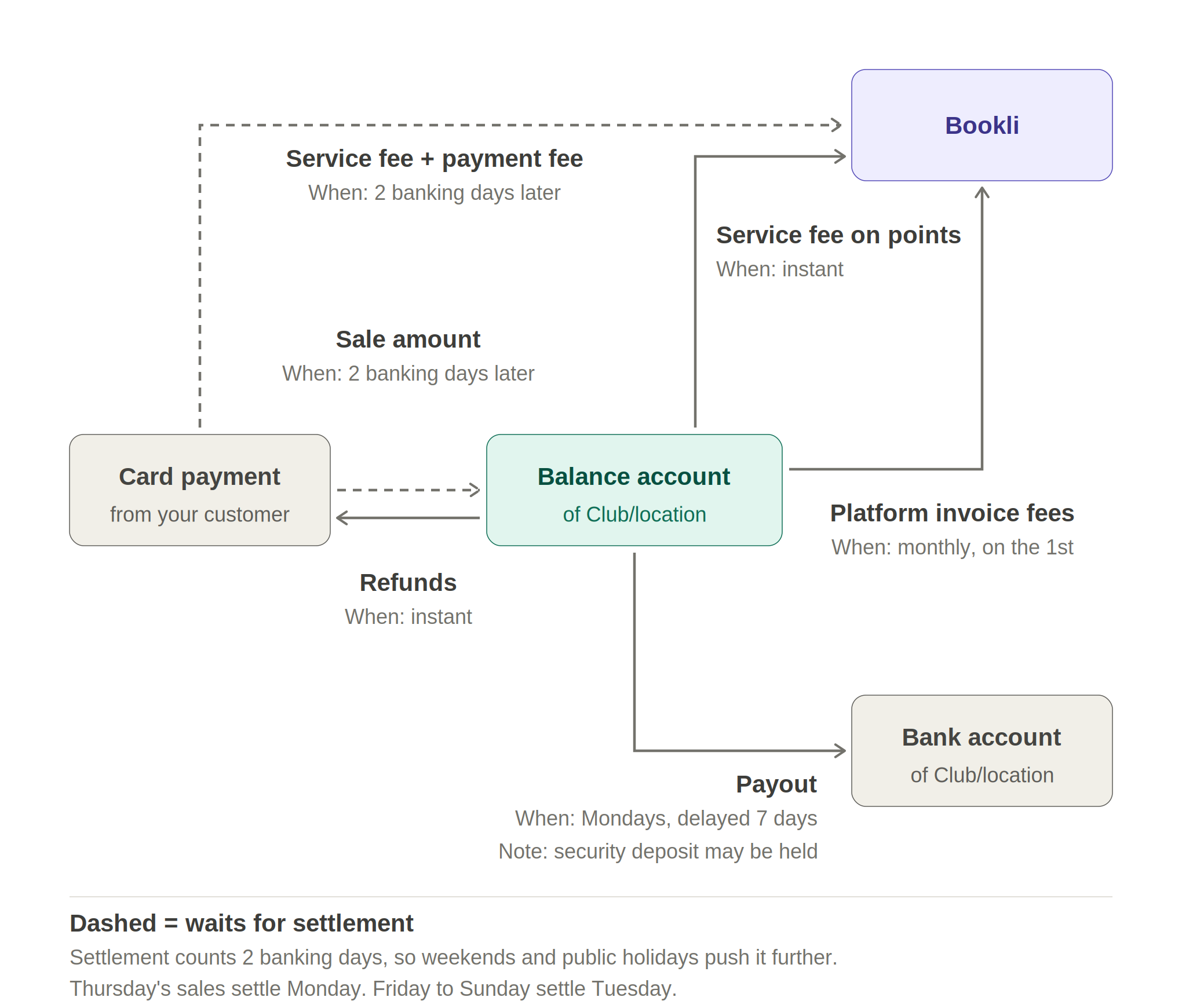
The diagram below provides an overview of how money moves in the system and when.
Why is my payout less than my balance?
Part of your balance is retained as a security buffer — This protects both you and your customers against refunds and chargebacks.
When do payouts occur?
Automatically every Monday morning. Manually created payouts can also appear in your history.
Can I see which payments a payout covers/contains?
No, you cannot. The balance account in Bookli is used constantly as a kind of bank account, where money is constantly flowing in and out, with different delays and processing times. Therefore, it must also be treated as a bank account for accounting purposes.
A payout from your balance account in Bookli is therefore equivalent to transferring money between two bank accounts, for example your salary account and your budget account, and it is therefore not possible to tell exactly which transactions are contained in a payout.
If necessary, ask your accountant about this - it is normal practice when accounting for card payments.